
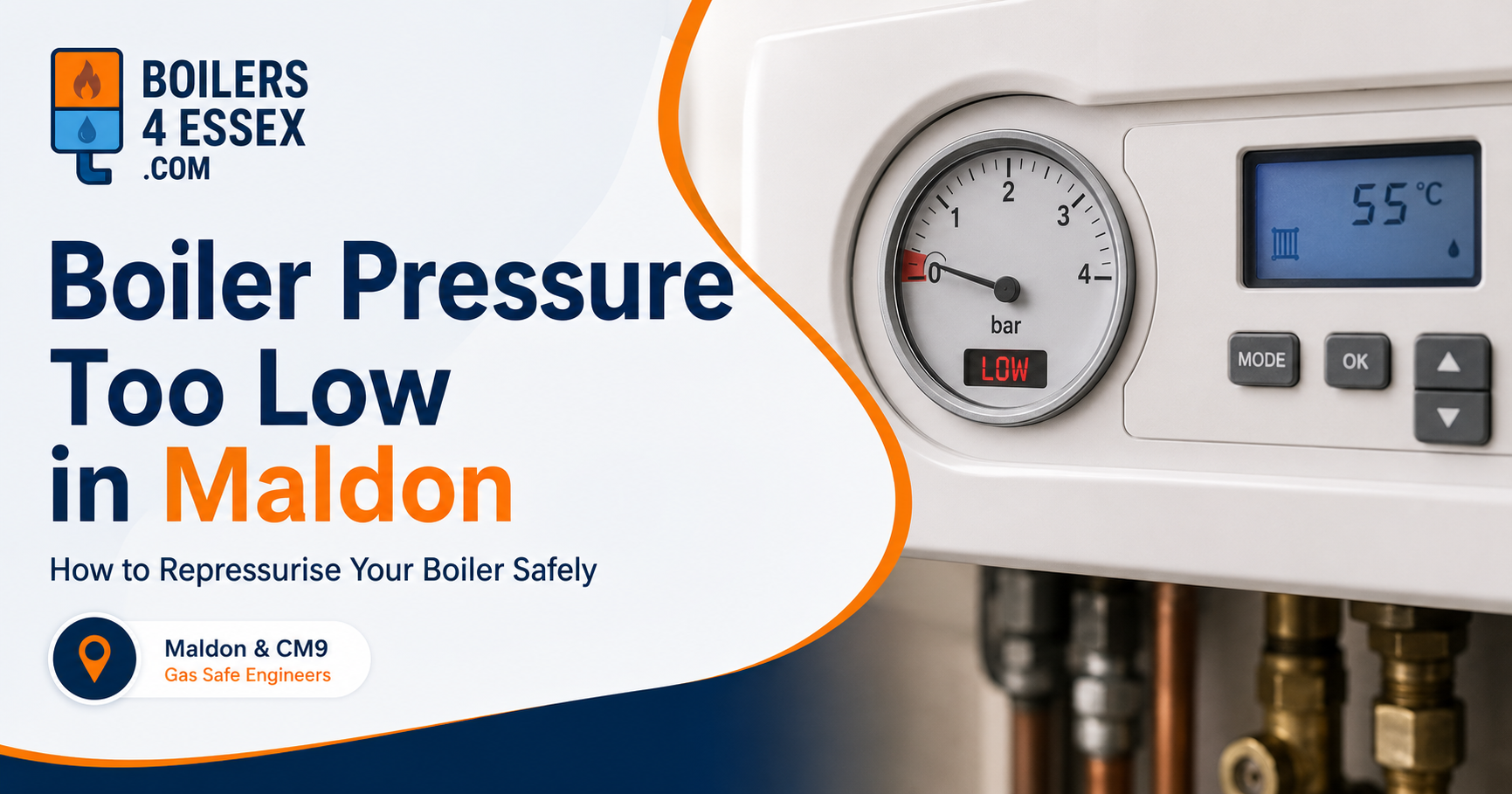
If your boiler pressure is too low in Maldon, your boiler may stop firing, show a low-pressure fault code or leave you without heating or hot water. In many sealed heating systems, you can restore the pressure using the boiler's filling system.
The method matters. Boilers use different filling loops, keys and built-in filling controls, so always follow the instructions for your exact make and model.
This guide explains how to check low boiler pressure, how to repressurise your boiler safely and when low pressure needs a professional boiler engineer in Maldon.
Quick answer:
If your boiler pressure is too low, switch the heating off and let the system cool. Check the pressure gauge and your boiler manual. If the manufacturer allows you to repressurise the system, use the correct filling method and slowly restore the recommended cold pressure. Close the filling controls fully afterwards. If the pressure soon drops again, stop repeatedly topping it up and book an engineer.
In This Guide
Boiler Pressure Too Low in Maldon: What Does It Mean?
A sealed central-heating system needs enough water pressure to move heated water around the system.
Most boilers show the pressure on a round gauge or digital display. The correct reading varies between appliances, so check the instructions for your boiler.
Many domestic sealed systems sit at around 1 to 1.5 bar when cold. However, use the figure stated by your boiler manufacturer rather than treating that range as a rule for every appliance.
For manufacturer guidance, see the Worcester Bosch boiler-pressure guide and Vaillant boiler-pressure guide.
Signs Your Boiler Pressure May Be Too Low
- the pressure gauge sits below its normal cold range
- the boiler displays a low-pressure warning
- a fault code appears
- the boiler refuses to fire
- the appliance goes into lockout
- heating or hot water stops working
- the pressure has fallen after bleeding radiators
Boiler Pressure Too Low or Pressure That Keeps Dropping?
These problems are linked, but they are not the same.
| What You See | What It May Mean | Best Next Step |
|---|---|---|
| Pressure low once | The system may simply need topping up. | Follow the boiler manufacturer's filling instructions. |
| Low after bleeding radiators | Bleeding released air and reduced system pressure. | Repressurise if the manufacturer recommends it. |
| Pressure falls every few days | Water may be escaping or another fault may exist. | Arrange an engineer visit. |
| Pressure drops soon after topping up | The underlying problem remains. | Stop repeatedly topping up and get the system checked. |
If your pressure keeps falling after you restore it, move to our dedicated guide to boiler losing pressure in Maldon.
Why Has My Boiler Pressure Gone Low?
Low pressure does not always mean that your boiler has a major fault.
Common reasons include:
- radiators were recently bled
- the heating system has not been topped up for some time
- a radiator valve or pipe joint is leaking
- water is escaping from the boiler
- a pressure relief valve is passing water
- the expansion vessel or another component has a fault
Check for Visible Leaks
Look around accessible radiator valves, pipe connections and the area below the boiler.
Watch for water droplets, damp patches, staining, corrosion around fittings or a puddle that returns after you dry it.
Do not remove the boiler casing to search for an internal leak.
How to Repressurise a Boiler Safely
Only repressurise your boiler if the manufacturer allows the homeowner to do it and you understand the controls.
The exact steps vary by boiler, but the general process looks like this:
Safe Repressurising Checklist
- Switch the boiler and heating off.
- Allow the system to cool.
- Check the current pressure.
- Identify the correct filling system.
- Open the filling control slowly.
- Watch the gauge as water enters the system.
- Stop at the cold pressure recommended by the manufacturer.
- Close every filling valve or control fully.
- Turn the boiler back on.
- Use the manufacturer's reset procedure if required.
Do not guess which valve to turn.
If you cannot identify the correct filling controls, stop and check the boiler manual. Never remove the boiler casing to look for them.
Different Ways to Repressurise a Boiler
Boilers do not all use the same filling system.
Your heating system may use:
- an external braided filling loop
- a built-in filling loop
- a keyless filling link
- a filling key
- another manufacturer-specific filling device
This is why generic online instructions can cause confusion. Match the method to your exact appliance.
External Braided Filling Loop
An external filling loop often looks like a short silver braided hose with controls at each end.
On a system designed for homeowner filling, opening the correct controls lets mains water enter the sealed heating circuit.
Open the controls slowly and watch the pressure gauge continuously.
Built-In or Keyless Filling Systems
Some newer boilers use a built-in filling link rather than a separate braided hose.
Worcester Bosch uses different filling arrangements across its boiler ranges and publishes instructions for each type.
See the Worcester Bosch repressurisation guides.
Vaillant Filling Systems
Vaillant explains that some systems use a filling loop while others use a filling key or another arrangement.
Follow the instructions for your exact Vaillant boiler rather than assuming every model fills in the same way.
See the Vaillant boiler repressurising guide.
What Pressure Should I Repressurise My Boiler To?
Use the cold-system pressure stated in your boiler manual.
Many domestic sealed systems use a cold reading around 1 to 1.5 bar. However, the correct figure varies between appliances.
Watch the gauge while you add water. Stop at the level given by the manufacturer.
Adding too much water can create the opposite problem and leave the boiler pressure too high.
What to Check After Repressurising Your Boiler
Once you have restored the pressure:
- make sure the filling controls are fully closed
- turn the boiler back on
- reset it only if the manufacturer's instructions tell you to
- check that the boiler fires normally
- look at the pressure again while the heating is warm
- check it again after the system cools
Useful engineer tip: Take a photo of the gauge after you top the system up. If the pressure drops again, the photo helps show how much pressure the system lost and how quickly it happened.
Boiler Pressure Too Low After Bleeding Radiators?
Bleeding a radiator releases trapped air.
That process can also reduce the pressure in a sealed heating system.
Check the boiler gauge afterwards. If the reading sits below the manufacturer's recommended range, the system may need repressurising.
Boiler Pressure Too Low and Boiler Won't Fire?
Some boilers stop operating when the system pressure becomes too low.
If restoring the pressure does not get the boiler running again, look for a fault code and follow the correct reset procedure.
Our live guide explains why a boiler won't fire up in Maldon.
Low Pressure With No Heating or Hot Water?
Low system pressure can stop some boilers from providing heating or hot water.
Check the pressure first. Then look at the boiler display for a warning or fault code.
If you still have no heating or hot water after restoring the correct pressure, use our no heating or hot water in Maldon guide.
Low Boiler Pressure With a Fault Code?
Many boilers display a warning when the system pressure becomes too low.
Take a photo of the code before resetting anything.
Our live boiler fault code in Maldon guide explains why the code gives an engineer a useful starting point.
Boiler Keeps Turning Off After Losing Pressure?
Some boilers go into lockout when the system pressure falls outside their working range.
If the boiler restarts after repressurising but soon shuts down again, another problem may still be present.
Read our guide to why a boiler keeps turning off in Maldon.
Boiler Still Not Working After Repressurising?
Restoring pressure will only solve the shutdown if low pressure caused it.
If the boiler still will not work, another fault may be stopping it.
Use our live boiler not working in Maldon guide for the next checks.
Low Pressure and Strange Boiler Noises?
Tell the engineer if the low pressure appears at the same time as gurgling, banging, humming or another new noise.
The sound can give extra clues about circulation, trapped air or another system issue.
See our boiler making strange noises in Maldon guide.
Should I Keep Repressurising My Boiler?
No, not if the pressure keeps falling.
A one-off top-up is different from having to add water every few days or weeks.
Repeated pressure loss may point to:
- a visible or hidden heating-system leak
- a leaking radiator valve
- a pressure relief valve passing water
- an expansion vessel problem
- another boiler or heating-system fault
If you are topping up the boiler regularly, use our boiler keeps losing pressure guide rather than treating every pressure drop as a one-off.
When Boiler Pressure Too Low Needs an Engineer
Arrange a professional check if:
- the pressure drops again soon after topping up
- you need to repressurise the boiler regularly
- you can see water leaking
- water comes from a pressure relief pipe
- the boiler still will not start
- the same fault code keeps returning
- the pressure changes dramatically when the heating runs
- you cannot identify the correct filling controls
- you are not confident topping up the system yourself
Boiler Pressure Too Low in Maldon?
If you have restored the pressure but it keeps falling, Boilers 4 Essex can find out why.
Our Gas Safe registered engineers diagnose boiler and heating-system pressure faults across Maldon and the surrounding CM9 area.
What Will an Engineer Check?
The engineer will first work out why the system has lost pressure.
Checks may include:
- radiators and valves
- visible heating pipework
- the boiler for internal water loss
- the pressure relief valve
- the expansion vessel
- system pressure when cold and hot
- the boiler's fault history
Finding the cause matters more than simply adding water back into the system.
How Much Does a Low-Pressure Boiler Repair Cost?
If the system only needs a normal homeowner top-up, you may not need a repair.
When the pressure keeps falling, the repair price depends on the cause. A leaking valve can cost very differently from a repair involving an expansion vessel or another boiler component.
See our live boiler repair cost in Maldon guide for more information.
Low Boiler Pressure Help in Maldon and CM9
Boilers 4 Essex provides boiler fault diagnosis and repair services throughout Maldon and the surrounding CM9 area.
We can investigate:
- boilers that repeatedly lose pressure
- low-pressure fault codes
- pressure relief valve problems
- expansion vessel faults
- boilers that will not fire after losing pressure
- heating systems that need frequent topping up
If your boiler pressure is too low in Maldon and you cannot restore it safely, visit our Boiler Repairs in Maldon page to arrange an engineer.
Important Gas Safety Advice
Low heating-system water pressure is different from a gas leak.
If you smell gas or suspect a gas emergency, call the National Gas Emergency Service on 0800 111 999.
Do not remove the boiler casing or work on gas, combustion or internal boiler components yourself.
You can read the official HSE domestic gas-safety guidance or check an engineer on the Gas Safe Register.
Boiler Pressure Too Low in Maldon: Frequently Asked Questions
What should I do if my boiler pressure is too low?
Check the pressure against the range in your boiler manual. If the manufacturer allows homeowner repressurising, use the correct filling system to slowly restore the recommended cold pressure.
What pressure should my boiler be when cold?
Many sealed heating systems sit around 1 to 1.5 bar when cold, but the correct figure varies by boiler. Always follow the instructions for your make and model.
Is it safe to repressurise my boiler myself?
Many manufacturers design their filling systems for homeowner use. Follow the instructions for your exact boiler and stop if you cannot identify the correct controls.
Why did my boiler pressure drop after bleeding the radiators?
Bleeding releases trapped air from the heating system and can reduce the system pressure. Check the gauge afterwards and top up only if the manufacturer recommends it.
Why does my boiler pressure keep dropping after I repressurise it?
Repeated pressure loss can point to a leak, pressure relief valve problem, expansion vessel fault or another heating-system issue. An engineer should find the cause rather than you continually adding water.
Can low boiler pressure stop the heating working?
Yes. Some boilers stop operating when system pressure falls below their required range. You may see a low-pressure fault code or boiler lockout.
Can I put too much pressure into my boiler?
Yes. Overfilling the heating system can raise the pressure above the recommended range. Watch the gauge while filling and stop at the level stated by the manufacturer.
Can Boilers 4 Essex help with low boiler pressure in Maldon?
Yes. Boilers 4 Essex provides boiler and heating-system pressure diagnosis and repairs throughout Maldon and the surrounding CM9 area.
Pressure Keeps Dropping?
A one-off top-up may solve low boiler pressure. Repeated pressure loss needs a proper diagnosis.
Boilers 4 Essex can find the cause and explain the repair needed.
Official Boiler Repressurising Guides
- Vaillant: How to repressurise a boiler
- Worcester Bosch: Boiler pressure
- Worcester Bosch: Repressurisation videos
Last updated: 13 August 2026. Boiler pressure ranges and filling methods vary by manufacturer and model. Always follow the instructions supplied for your exact appliance.
