
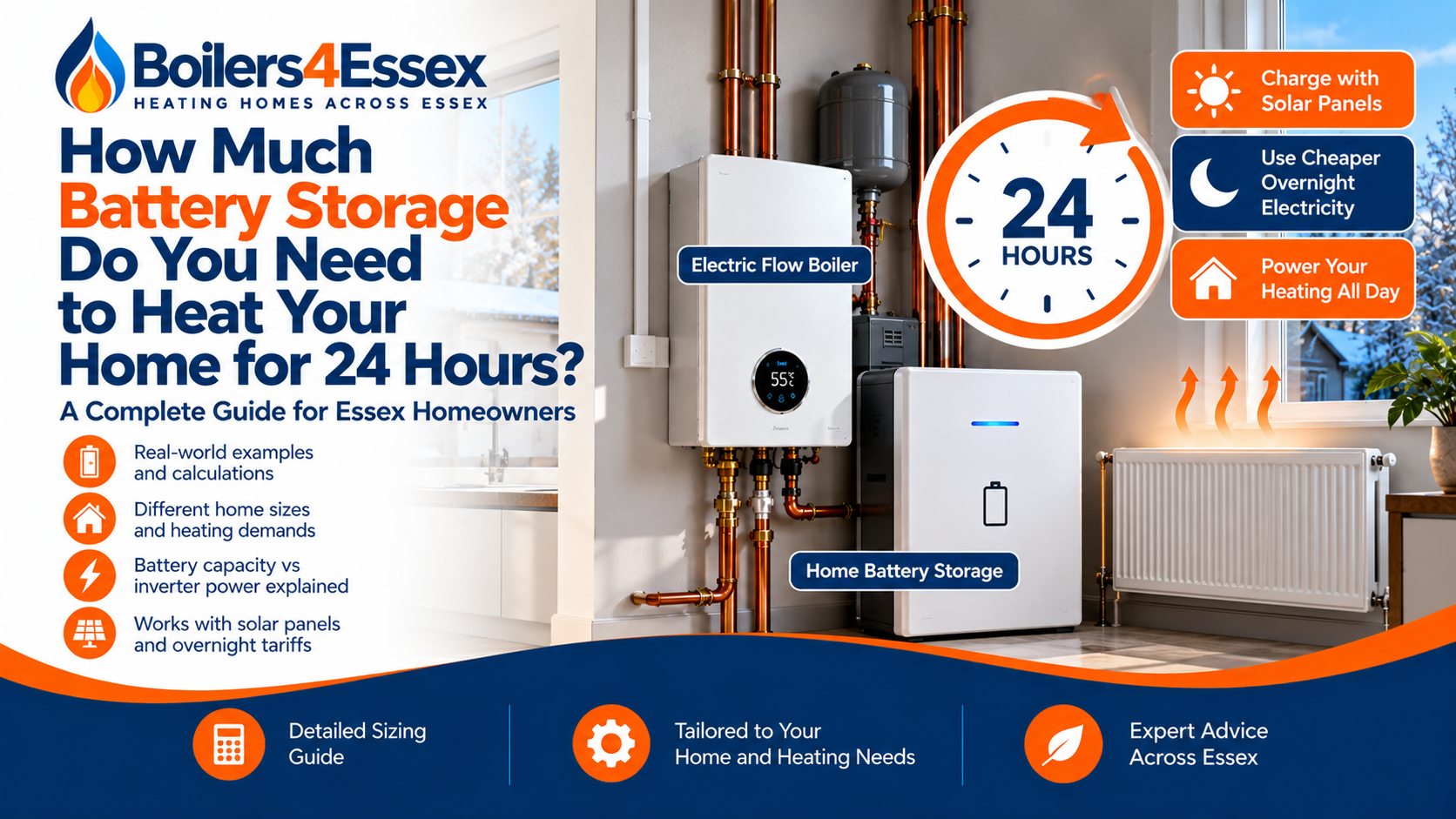
Quick answer: A battery designed to run household appliances overnight may be far too small to power electric central heating for an entire day. The correct battery size depends on how much heat the property needs during cold weather, the electricity consumed by other appliances and the performance of the battery system.
Why property heat loss matters
Two homes with the same number of bedrooms can have very different heating requirements. Insulation, glazing, floor area, air leakage, exposure and thermostat settings can all influence winter consumption.
Battery specification should therefore begin with a property heat-loss calculation and an estimate of electrical consumption on a defined cold day. Annual averages are useful for energy budgeting but cannot guarantee full-day winter coverage.
Example: calculating the daily requirement
Consider an illustrative home with 45 kWh of space heating and hot-water electricity demand and 12 kWh of other household electricity use over a cold 24-hour period.
| Electricity requirement | Daily consumption |
|---|---|
| Heating and hot water | 45 kWh |
| Household appliances | 12 kWh |
| Total electricity | 57 kWh |
| Nominal storage at 90% usable fraction, before further losses | 63.3 kWh |
These figures are illustrative. A genuine design must calculate usable AC energy, operating reserve, inverter losses, battery restrictions, ageing allowances and the worst conditions the customer expects the system to cover.
What happens on colder days?
A home requiring 57 kWh on one winter day might need substantially more during very cold weather. If the calculated demand rises to 85 kWh, a system sized for 57 kWh will not meet that day's requirement without extra electricity or heat from elsewhere.
Any claim that a battery will provide complete 24-hour coverage must state its design conditions and the contingency for prolonged cold periods.
Why inverter output is equally important
A 12 kW electric boiler requires sufficient instantaneous power even if the battery has plenty of stored energy. Cooking, showers, hot-water heating and household appliances can add to the simultaneous demand.
The inverter and electrical installation must be selected for the maximum intended power. Read how electric boilers run from home battery storage.
Can the battery recharge during a short night tariff?
Suppose 70 kWh must be purchased over seven off-peak hours. Average import is then 10 kW, and additional household or boiler consumption during that period increases the total demand.
Charging equipment, the incoming supply and battery acceptance limits must all be capable of meeting the planned charging schedule. Learn about electrical supply requirements and overnight tariffs.
Can solar panels reduce battery requirements?
Solar generation can reduce grid electricity purchases, but a dependable cold-weather heating design should not assume sunshine on a dark winter day. Solar production should be modelled separately as a benefit, with a conservative low-generation case.
Read our guide to solar generation in winter.
Getting the balance right
Installing too little storage may prevent the system achieving its intended coverage, while unnecessary excess capacity increases costs. Boilers 4 Essex can help homeowners explore the heating requirements that should inform a complete proposed system.
Frequently Asked Questions
Is 10 kWh enough to heat a house for 24 hours?
For most whole-house resistance-heating applications, 10 kWh would be insufficient, but the answer depends on actual demand.
What is the difference between kW and kWh?
kW measures the rate of power delivery. kWh measures the amount of energy stored or consumed.
Should solar output be included in guaranteed battery coverage?
Any defined full-day coverage claim should use explicit and suitably conservative assumptions about available solar generation.
Explore our electric boiler services in Essex, our oil boiler services, or contact Boilers 4 Essex.
Information note: Any figures are illustrative unless stated otherwise. Tariff availability, heating costs, equipment suitability, savings and 24-hour battery coverage depend on individual circumstances. No savings or full-day autonomy are guaranteed without a property-specific design and assessment.
