
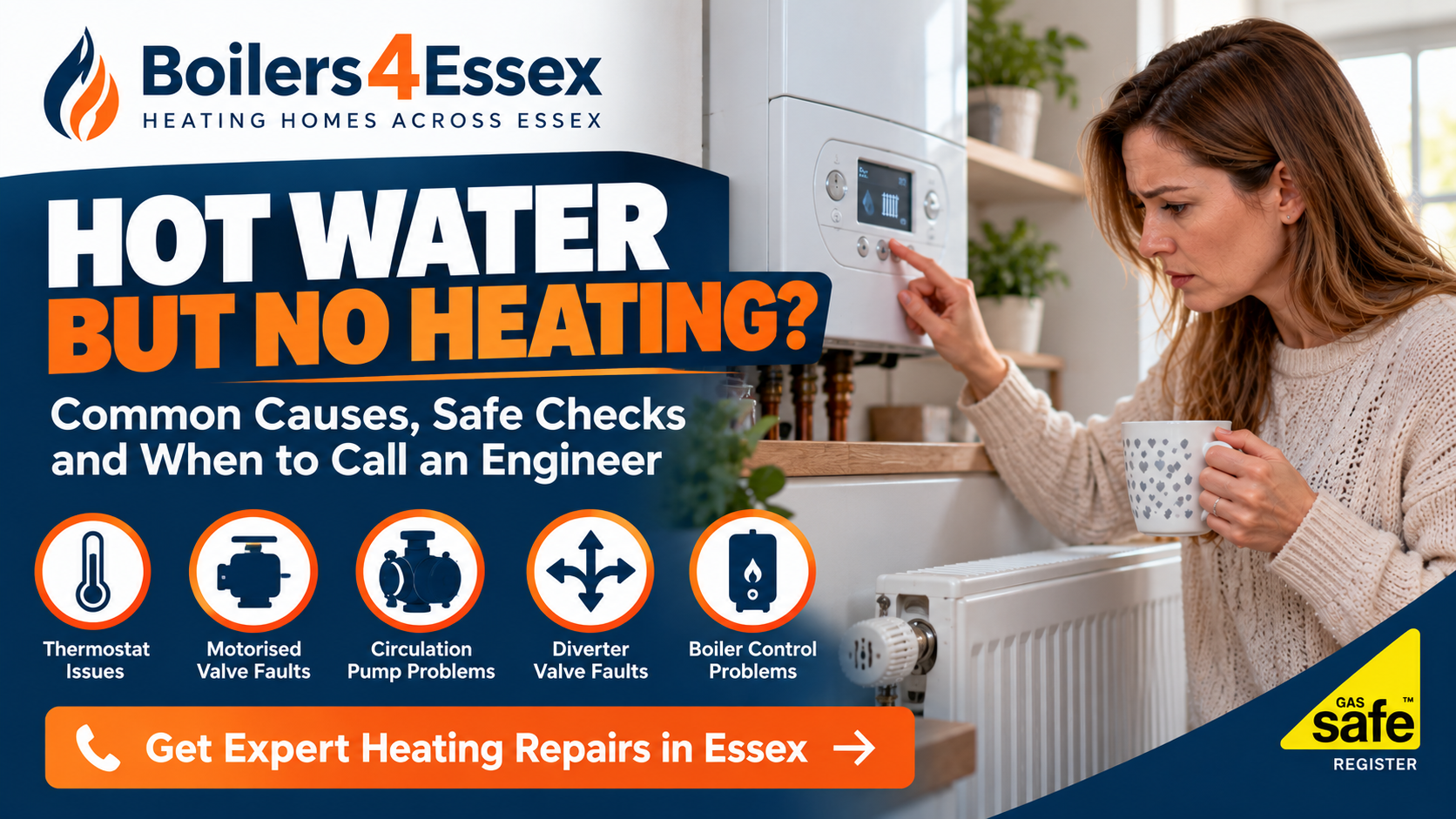
Have you got hot water but no heating? If your taps and shower are working normally but your radiators remain cold, you could have a problem with your thermostat, heating controls, circulation pump, motorised valve or boiler.
The cause depends on your heating system. A combi boiler works differently from a system or conventional boiler with a hot-water cylinder, so the same symptoms can require different repairs.
Boilers 4 Essex provides boiler and central heating fault diagnosis across Essex. In this guide, we explain what the symptoms could mean, which checks you can safely make and when to arrange a professional boiler repair in Essex.
Quick Answer: Why Do I Have Hot Water but No Heating?
If you have hot water but your radiators are cold, first check that the central heating is switched on, the thermostat is requesting heat and the heating schedule is correct.
If those settings are correct, possible causes include:
- A faulty room thermostat or smart heating receiver.
- A boiler set to hot-water-only mode.
- A faulty diverter valve in some combi boilers.
- A circulation pump or restricted water flow.
- A stuck motorised valve on a zoned or cylinder-based system.
- Low boiler pressure or another boiler fault.
These are possible causes, not a definitive diagnosis. Different heating systems use different components. If the simple checks do not restore heating, an engineer should investigate before replacement parts are ordered.
Hot Water Working but No Central Heating?
If your radiators are still cold, Boilers 4 Essex can investigate faults involving boiler controls, diverter valves, circulation pumps and motorised valves.
Arrange professional heating fault diagnosis anywhere across Essex.
Repair enquiries and appointments are subject to availability. Additional work is quoted as required.
What Does Hot Water but No Heating Actually Mean?
A central heating system normally has two separate requirements: supplying heat to the radiators and supplying hot water to taps and showers.
Although both services may rely on the same boiler, they do not always use exactly the same controls, valves or flow paths.
This explains why one service may work while the other fails.
Why the Type of Boiler Matters
With a combi boiler, your hot tap normally triggers the boiler to produce hot water directly. The central heating relies on a separate heating demand from the thermostat or heating controller.
With a system or conventional boiler, there may be a stored hot-water cylinder and external motorised valves controlling the heating and hot-water circuits.
If you have a hot-water cylinder, hot water at the tap does not necessarily prove the boiler is currently working. The cylinder may still contain previously heated water, or an immersion heater may be providing hot water independently.
Tell your engineer whether you have a cylinder and whether its immersion heater is switched on. This can significantly change the diagnosis.
Hot Water Working but No Heating? 6 Safe Checks to Make First
Before assuming a pump or boiler component has failed, check the normal user controls. These checks do not require you to open the boiler or remove electrical covers.
1. Is Your Thermostat Requesting Heat?
A room thermostat only calls for heating when the room temperature is below the selected setting.
Temporarily increase the target temperature above the room temperature and check whether the heating system responds.
If you have a wireless thermostat, check its battery status and whether it is communicating with the receiver.
A thermostat or receiver fault may prevent central heating from starting even though the boiler produces hot water normally.
2. Is the Heating Programmer Switched On?
Check your programmer, timer or smart heating schedule. Make sure the central heating is enabled at the time you are trying to use it.
Look for:
- Incorrect heating times.
- Holiday or away mode.
- Heating manually switched off.
- Incorrect time or date following a power cut.
- Separate heating zones that have been disabled.
3. Is the Boiler in Summer or Hot-Water-Only Mode?
Some boilers have a summer setting that provides domestic hot water without supplying central heating.
The boiler can appear to be working normally when a hot tap is opened, but the heating will remain off.
Check the display and change the setting only according to the user instructions for your model.
Manufacturer guidance from Vaillant also recommends checking heating mode and controls when hot water works but central heating does not.
4. Are the Radiator Valves Open?
Check that the radiators you want to heat have not been turned down or switched off.
Thermostatic radiator valves (TRVs) are frequently adjusted during warmer weather. A radiator can stay cold if its TRV is set below the room temperature.
However, if every radiator is cold even when the heating is requested, the fault may be somewhere else in the system.
5. Is the Boiler Pressure Correct?
On a sealed heating system, look at the boiler's pressure gauge or digital pressure reading.
Compare the reading with the recommended range in your boiler manual.
Low pressure can stop some boilers operating normally. Do not guess at the correct pressure or repeatedly add water without investigating why the pressure has fallen.
For more information, see our guide to low boiler pressure and safe checks .
6. Is the Boiler Showing a Fault Code?
Look for any error messages, warning symbols or flashing lights on the boiler display.
Take a photograph of the code and note what happens when the thermostat asks for heating.
If the boiler repeatedly locks out, avoid continually resetting it. A recurring fault needs professional diagnosis.
Your boiler make and model, the displayed pressure, any fault code, whether hot water works continuously, and whether any radiators become warm.
These details can help an engineer understand your heating problem before attending.
Combi Boiler or Hot-Water Cylinder? Find the Right Fault
The layout of your heating system is one of the most useful clues when investigating hot water working but no central heating.
Combi Boiler
Usually produces hot water directly when a tap is opened, without a separate stored hot-water cylinder.
Possible faults: thermostat, heating settings, diverter valve, pump, pressure or internal boiler controls.
System or Conventional Boiler
Commonly works with a separate hot-water cylinder. Heating and hot water may be controlled by separate valves and thermostats.
Possible faults: motorised zone valves, programmer, room thermostat, circulating pump or heating circuit.
Not sure which boiler you have? Boilers 4 Essex works with combi boilers, system boilers and heat-only boilers.
Combi Boiler Giving Hot Water but No Heating
A combi boiler is designed to provide domestic hot water and central heating from one appliance.
When you open a hot tap, the boiler responds to the hot-water demand. When the room thermostat requests heat, the boiler should operate in central-heating mode.
Some combi boilers use an internal diverter valve to direct heating water through the appropriate circuit.
Could the Combi Boiler Diverter Valve Be Faulty?
Yes. A diverter valve that sticks or fails to operate correctly can sometimes leave the hot-water service working while central heating does not operate normally.
Possible signs include:
- Hot taps work but radiators remain cold.
- The boiler behaves differently when heating is requested.
- Heating works intermittently.
- The boiler does not appear to switch correctly between demands.
However, these symptoms can also be caused by controls, circulation and other boiler faults. They do not prove the diverter valve is defective.
An engineer needs to confirm whether the fault is with the valve actuator, valve mechanism or another component.
Could the Combi Boiler Pump Be Faulty?
The central heating circuit relies on adequate water circulation.
Depending on the model, a pump fault or restricted flow can prevent the heating from operating correctly, cause poor radiator performance or trigger a boiler shutdown.
A circulation fault may need testing of the pump and the wider heating circuit.
Combi Boiler Hot Water Works but Thermostat Does Nothing
If the boiler responds to hot taps but does not respond to the room thermostat, the first checks should involve heating mode, thermostat demand and the controls.
An engineer may then test whether the heating demand is reaching the boiler and whether its internal controls respond correctly.
Do not remove the boiler casing or test live electrical connections yourself.
Hot Water but No Heating With a System or Conventional Boiler
System and conventional heating arrangements often have a separate hot-water cylinder and external control components.
Depending on the installation, these may include a two-port zone valve, a three-port motorised valve, a cylinder thermostat and separate heating controls.
Motorised Valve Not Opening for Central Heating
A motorised valve is designed to control the flow of heated water through part of the heating system.
If the valve serving the heating circuit does not operate correctly, you may still have hot water while the radiators stay cold.
The cause could be a failed actuator, a valve mechanism that has seized, or a problem with the wiring or controls.
Two-Port and Three-Port Valve Problems
A two-port valve controls flow through one circuit. Some heating systems use separate valves for the central heating and hot-water cylinder circuits.
A three-port valve can direct water between heating and hot-water circuits in certain system configurations.
A failure involving either valve type can interfere with the normal operation of central heating.
Do not assume the whole valve needs replacing. The actuator and valve body should be assessed before deciding on a repair.
Hot Water Only Working Through the Immersion Heater?
Some hot-water cylinders contain an electric immersion heater that can heat stored water independently of the boiler.
This means hot water may remain available even when the gas boiler is not heating either circuit.
If you have a cylinder, note whether the immersion heater is in use and tell the engineer when booking your repair.
On cylinder-based heating systems, a combination of working hot water, cold radiators and a thermostat requesting heat can suggest a control or valve issue. But the pump, boiler operation and system configuration must also be considered.
5 Heating Components That Can Cause Hot Water but No Heating
1. Room Thermostat or Smart Heating Controls
A faulty thermostat may fail to request central heating even though the hot-water function continues to operate.
Smart controls such as Hive and Nest can also develop communication, programming or receiver faults.
Professional testing can help distinguish between a thermostat problem and an issue elsewhere in the heating controls.
2. Combi Boiler Diverter Valve
A diverter valve can affect how certain combi boilers switch between domestic hot water and central heating.
If the mechanism sticks or the actuator fails, the boiler may not provide heat to the radiators as intended.
3. Central Heating Circulation Pump
The pump helps move heated water around the central heating system.
Electrical faults, mechanical failure, trapped air or restricted circulation can affect heating performance.
A pump should be tested before replacement, as similar symptoms can have other causes.
4. Two-Port or Three-Port Motorised Valve
Motorised valves are commonly used on heating systems with stored hot water and separately controlled heating zones.
A valve that fails to open correctly can prevent heated water reaching a particular circuit.
Testing may be needed to identify a faulty actuator, seized valve or control problem.
5. Boiler Sensors or Electronic Controls
Modern boilers use sensors and electronic controls to manage heating operation.
An internal control fault can affect the central heating function even when another function appears normal.
Proper diagnosis is necessary before replacing electronic components.
Think You Have a Faulty Pump, Valve or Thermostat?
Replacing the wrong component can waste time and money. Boilers 4 Essex can investigate the heating controls, boiler and circulation system to identify the underlying problem.
Hot Water but No Heating: Quick Fault Diagnosis Table
Use this table to identify which parts of your heating system may need attention. It is a symptom guide, not a diagnosis.
| Symptom | Possible Cause | Recommended Action |
|---|---|---|
| Hot water works but all radiators are cold | Heating settings, thermostat, diverter valve, pump or zone valve | Check heating demand and controls first. |
| Combi boiler works for taps but not heating | Heating mode, controls, diverter valve or circulation problem | Arrange diagnosis if safe settings checks fail. |
| Thermostat turned up but boiler does nothing | Thermostat, receiver, controls or boiler demand fault | Check schedule and batteries; arrange testing if necessary. |
| Hot-water cylinder warm but radiators cold | Motorised valve, zone controls, circulation or boiler fault | Check heating schedule; tell the engineer about the cylinder. |
| Downstairs heating works but upstairs does not | Zone control, valves, balancing or restricted flow | Check relevant thermostats and radiator settings. |
| Heating briefly starts then shuts down | Circulation, temperature sensor, pressure or boiler fault | Record any fault code and arrange diagnosis. |
| One radiator cold but others warm | Radiator valve, trapped air or local restriction | Check the affected radiator rather than assuming a boiler fault. |
| Hot water remains available only from immersion | Boiler, controls or heating-system failure | Arrange professional heating diagnosis. |
If both your heating and hot water have stopped, our guide to no heating or hot water explains the first safe checks for a more complete boiler failure.
Hot Water Works but Only One Radiator Is Cold?
If most radiators are getting hot, your central heating system is at least circulating water through part of the property.
The problem may be local to the cold radiator. Possible causes include a closed or stuck thermostatic radiator valve, trapped air, restricted circulation or poor balancing.
A radiator that is cold at the top may contain trapped air. A persistent cold area towards the bottom may be associated with sludge or restricted flow.
However, temperature patterns alone cannot confirm the exact fault.
Boilers 4 Essex can investigate radiator problems as part of its heating and boiler repair services .
What Will a Heating Engineer Check?
A professional diagnosis should establish whether the problem lies in the heating controls, boiler or water circulation system.
Depending on the boiler and heating configuration, checks may include:
- Confirming the boiler type and heating-system layout.
- Checking the thermostat and programmer for a central heating demand.
- Checking whether the boiler receives and responds to that heating demand.
- Inspecting relevant motorised valves and heating-zone controls.
- Checking circulation pump operation and water-flow conditions.
- Investigating diverter-valve operation where appropriate.
- Checking pressure, fault-code history, sensors and associated boiler components.
- Confirming the diagnosis before recommending replacement parts or additional work.
This avoids treating every no-heating fault as a failed boiler.
How Much Does It Cost to Fix Hot Water but No Heating?
Repair costs depend on which component has failed, the boiler model and the amount of labour involved.
A straightforward thermostat problem can require very different work from replacing a diverter valve or central heating pump.
| Possible Repair | What Influences the Cost? |
|---|---|
| Room thermostat | Control type, fault diagnosis and replacement requirements. |
| Smart heating receiver | Receiver model, compatibility and installation work. |
| Motorised valve | Actuator-only repair versus complete valve replacement. |
| Central heating pump | Pump type, accessibility and associated system work. |
| Combi diverter valve | Boiler model, part availability and labour. |
| Boiler electronic fault | Component diagnosis, replacement parts and repair complexity. |
A professional diagnosis helps establish which repair is actually needed.
Boilers 4 Essex can discuss the applicable attendance charge and explain how any additional repair work is quoted.
For more information, see our boiler repair costs guide . The figures discussed there are general guidance, not a fixed quotation for this fault.
Hot Water but No Heating: Repair or Replace the Boiler?
Having hot water but no central heating does not automatically mean you need a new boiler.
In many cases, the underlying problem involves a repairable component or an issue elsewhere in the heating system.
Boiler replacement may become worth considering if the appliance is approaching the end of its useful life, requires repeated expensive repairs or has major components that are no longer economical to replace.
Before making that decision, an engineer should consider the boiler condition, the diagnosed fault, availability of parts and the expected repair cost.
If replacement is the sensible option, Boilers 4 Essex also provides new boiler installation across Essex . Replacement installations are subject to the appropriate survey and quotation.
Hot Water but No Heating? Boiler Repairs Across Essex
Boilers 4 Essex provides professional heating-system fault diagnosis and boiler repairs for homeowners and landlords throughout Essex.
We can investigate:
- Hot water working but no central heating.
- Combi boiler diverter-valve problems.
- Central heating pumps not operating correctly.
- Two-port and three-port motorised-valve faults.
- Hive, Nest and traditional heating-control issues.
- Radiators that stay cold despite heating demand.
- Boiler fault codes and recurring lockouts.
- Heating zones that do not respond to the thermostat.
Local Heating Engineers in Essex
Our coverage includes Chelmsford, Maldon, Brentwood, Basildon, Rayleigh, Grays, South Ockendon, Thurrock, Colchester, Southend and surrounding Essex areas.
Explore our local service information:
- Boiler Repairs in Chelmsford
- Boiler Repairs in Maldon
- Boiler Repairs in Basildon
- Boiler Repairs in Grays
- Boiler Repairs in Rayleigh
You do not need to know whether the fault is a pump, valve or thermostat before contacting us. Tell us the symptoms and the boiler model where possible.
Need Your Central Heating Repaired?
If your hot water works but the radiators stay cold, Boilers 4 Essex can arrange professional fault diagnosis and advise on the appropriate repair.
Local heating engineers serving homeowners throughout Essex.
Important Boiler and Heating Safety Advice
Checking a thermostat, heating schedule, boiler display or radiator valve is different from repairing a boiler.
Do not remove boiler casings, dismantle motorised valves, access electrical heating-control wiring or attempt internal gas boiler repairs.
Work on gas appliances must be carried out by a Gas Safe registered engineer qualified for the relevant appliance.
If you smell gas or suspect a gas leak, call the National Gas Emergency Service on 0800 111 999. Do not use electrical switches or naked flames. Follow the emergency service's instructions.
For official guidance, visit the Health and Safety Executive's gas safety advice .
Hot Water but No Heating: Frequently Asked Questions
Why do I have hot water but no heating?
Your boiler or heating system may still provide hot water while the radiator circuit is not operating correctly. Common possibilities include thermostat settings, heating controls, a diverter valve, motorised valve or circulation problem. The cause depends on your heating-system configuration.
Why does my combi boiler heat water but not radiators?
A combi boiler may respond to hot-water demand while a separate central heating fault prevents the radiators from warming. Check heating mode and thermostat settings. A diverter valve, pump or internal component fault may also need investigation.
Can a faulty diverter valve cause hot water but no heating?
Yes. A diverter valve fault on some combi boilers can affect how heated water is directed between domestic hot water and central heating. An engineer should test the component before recommending replacement.
Can a faulty central heating pump cause no heating?
Yes. A circulation pump fault can restrict or prevent heating water moving around the radiator circuit. However, similar symptoms may arise from other circulation or control problems.
Can a motorised valve cause hot water but no heating?
Yes. On systems with separate heating and hot-water circuits, a motorised valve that does not operate correctly can prevent heated water reaching the radiators.
Why is my thermostat on but the boiler not heating?
The thermostat may not be communicating correctly with the heating controller, the schedule may be inactive or another component may be preventing the boiler from responding to heating demand.
Why do I have hot water but no heating upstairs?
If downstairs heating works normally but upstairs radiators stay cold, a heating-zone problem, valve issue, poor balancing or restricted circulation could be involved. Check any separate upstairs thermostat and radiator settings.
Does hot water working mean my boiler is fine?
Not necessarily. A combi boiler may still have a central-heating fault. If you have a hot-water cylinder, previously stored hot water or an immersion heater may explain why taps remain hot even when the boiler is not operating correctly.
Should I bleed radiators if I have hot water but no heating?
Bleeding may help if an individual radiator contains trapped air, often indicated by a cold upper section. If every radiator is completely cold, check the heating controls first. Always follow appropriate safety and manufacturer instructions.
Do I need a new boiler if hot water works but heating does not?
No, not automatically. Many faults involve components that can be repaired or replaced. The condition and age of the boiler, the diagnosed fault and the repair cost should be considered before deciding on replacement.
Can Boilers 4 Essex repair hot water but no heating faults?
Yes. Boilers 4 Essex provides boiler and central heating fault diagnosis throughout Essex. Our engineers can investigate heating controls, boiler components, circulation problems, pumps and motorised valves.
Hot Water but Still No Heating? Contact Boilers 4 Essex
Your boiler might not need replacing. The fault could be a thermostat, circulation pump, motorised valve, diverter valve or another repairable part of the heating system.
Boilers 4 Essex provides professional boiler and heating repairs throughout Essex, helping homeowners identify faults and get their heating working again.
Call 01708 693055 or complete our online enquiry form. Please include your postcode, boiler model and a brief description of the heating fault.
About Boilers 4 Essex
Boilers 4 Essex is an established Essex heating company providing boiler installations, repairs, servicing and wider central heating support.
Our work covers domestic heating systems including combi boilers, system boilers, conventional boilers, radiators, heating controls and associated components.
Gas boiler work is carried out by appropriately qualified Gas Safe registered engineers.
For further information about our services, visit Boilers 4 Essex or contact our team .
Helpful Manufacturer and Safety References
- Vaillant: Boiler Gives Hot Water but No Heating
- Vaillant: Common Boiler Problems
- HSE: Gas Safety Advice for Homeowners
- Gas Safe Register: Check an Engineer
Heating-system layouts and boiler controls vary by manufacturer and installation. Always follow the instructions for your particular appliance. The information in this guide is general advice and cannot confirm the cause of an individual fault.
